Self-
Bodywork™
/ˈself ˈbɒdi wɜːk/ · Practical Application
The intentional, educated application of sustained tension to your own fascial tissue, using breath and time under tension, to release restriction, restore hydration, and reorganize your body from the inside out.
tension for fascia to respond
beats 90 min weekly
cycle
than muscle
Everything
you need to know.
Self-Bodywork™
in its simplest
form.
Massage helps for a day. Self-bodywork helps for life. It teaches you how to read your own fascia, where tension starts, how it travels, and how to bring your body back into balance. No practitioner required.
With sustained tension, the right tools, and focused breath, you work directly with your fascia to release tension, calm your nervous system, and restore circulation. When practiced consistently, these small interventions stop everyday tightness from becoming chronic pain.
The result? A body that's fluid, responsive, and resilient. Not because someone fixed it. Because you did.
The 6 Principles
of Self-Bodywork.
These principles didn't begin as a philosophy. They began as a realization developed over years of hands-on experience, failure, and listening carefully to the body itself.
No one can reorganize your body for you. Only you can apply sustained tension consistently. Only you can give fascia the time it requires to change.
You cannot do this work blindly. You must learn the language of your body. Education creates agency. Agency creates consistency. Consistency creates change.
Fascia does not respond to force. It responds to time. Fascia requires repeated, sustained input to reorganize. Time under tension is the mechanism.
Hydration is what allows change to occur. It reduces resistance in the tissue. The more hydrated your system, the easier it becomes to access restricted areas.
The only delivery system that matches fascia's biology. No practitioner can create the environment of time, frequency, and control that only you can.
We start at the center and work outward. Foundations first. Extremities later. When the center regains space, the rest of the body has something to organize around.
Why self-bodywork
actually works.
This is not theory. Over 16 years of hands-on fascia work, we identified six biological mechanisms that explain exactly why self-bodywork produces results that massage, stretching, and foam rolling cannot.
Under slow, sustained tension, fascia behaves like a fluid. Under fast, forceful force it resists. This is why foam rolling doesn't change structure.
Restricted fascia has a gel-like consistency. Sustained mechanical input converts it from gel to sol, allowing adhesions to release and layers to glide again.
Collagen fibers in fascia are piezoelectric -- they generate a small electrical charge under mechanical stress that signals fibroblasts to remodel the collagen matrix.
Fascial layers glide on a film of hyaluronic acid (HA). Chronic compression causes HA to polymerize. Sustained tension disperses this gel, restoring glide between layers.
Fascia contains far more sensory receptors than previously understood. Interstitial receptors respond to slow, sustained tension by downregulating sympathetic tone.
Fibroblasts remodel the collagen matrix in response to sustained mechanical load. The 90-day collagen cycle means real structural change is possible with consistent input.

The 6 Foundational
Releases.
These are the six core releases used in real fascia work. Each targets where the modern body holds chronic tension.
Three tools.
Everything changes.

The primary release tool. Applies broad, sustained tension directly into fascial tissue. Its density is calibrated to find the edge of sensation without triggering the nervous system to brace.
Elevation changes everything. The foam block positions your body at the precise angle required to access deeper fascial layers, particularly the psoas and hip flexors.
Precision where the foam ball can't reach. Targets smaller, denser areas: calves, feet, jaw, occipital ridge.
How to practice
self-bodywork.
Start at the center of your body and work outward. Identify the area that feels most restricted, dense, or tender.
Place the foam ball or hard ball directly under the target area. Use gravity as your primary source of tension. Let your body weight do the work, not force.
Sink into the tool slowly. Find the edge of sensation. Enough to feel it, not so much that your system braces against it.
Hold. Stay. Give it time under tension. Wait for the softening, the warmth, the release. That's the tissue reorganizing.
Your breath is part of the release. Slow diaphragmatic breathing signals safety to your nervous system.
This is a practice, not a treatment. 15 minutes daily will do more than 90 minutes once a week.
Under.
Tension.
Fascia does not respond to force. It responds to time under tension. Most people release too soon. That's why nothing changes.
Self-bodywork
does this.
| Approach | Self-Bodywork | Foam Rolling | Massage | Stretching |
|---|---|---|---|---|
| Targets fascia directly | ||||
| 90s+ sustained hold | ||||
| Can be done daily | ||||
| Creates lasting change | ||||
| You're in control | ||||
| Teaches body literacy | ||||
| Accumulates over time |
Watch Self-Bodywork
in action.
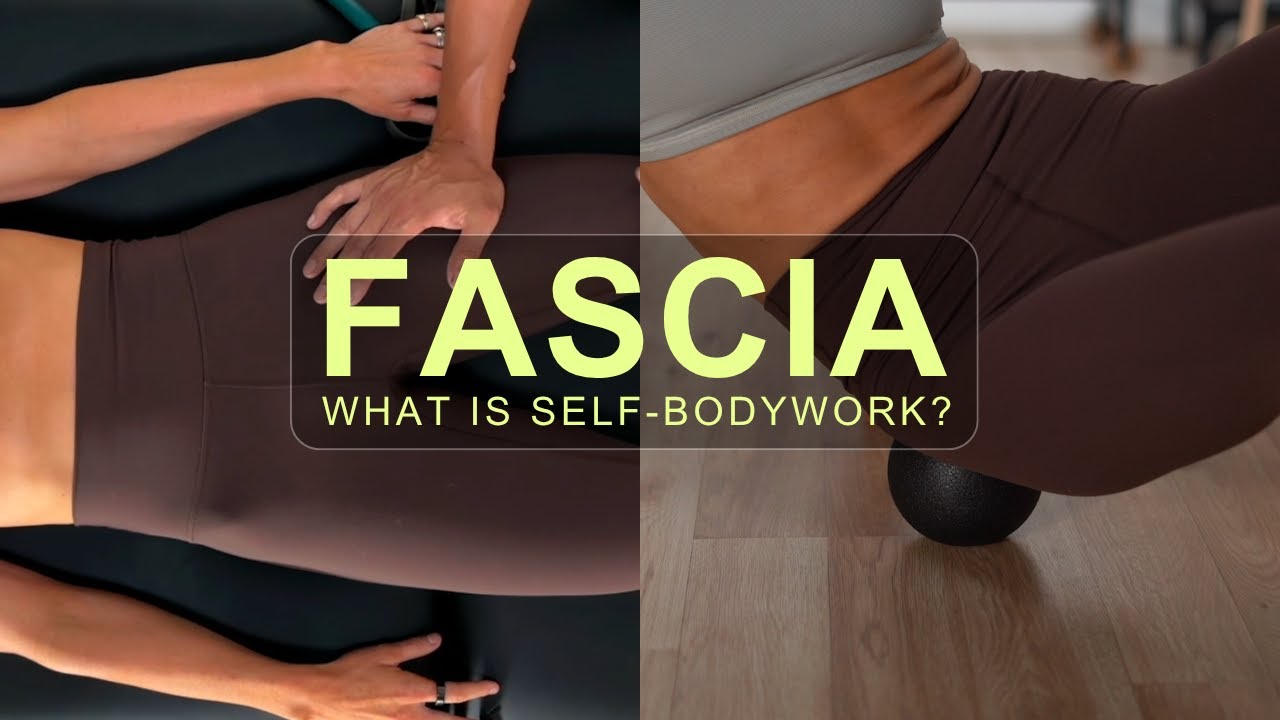
Marco Guizar breaks down what self-bodywork actually is, why fascia is the missing piece in most pain stories, and how sustained pressure creates real lasting change in the body.
Common
questions
about
self-bodywork.
Everything we get asked. Answered directly, without fluff.
Self-bodywork is the intentional, educated application of sustained tension to your own fascial tissue using breath, time under tension, and the right tools. Unlike massage, self-bodywork puts you in complete control and can be practiced daily at home.
Massage works on you for a session. Self-bodywork teaches you how to work on yourself consistently. Fascia requires sustained time under tension to respond and reorganize. Self-bodywork creates long-term structural change.
Fascia responds to time under tension, not to the clock. Hold until you feel the tissue change: a warmth, a softening, a release. That's your cue, not a timer.
No. Foam rolling is typically fast, high-pressure, and targets muscle tissue. Self-bodywork is slow, sustained, and specifically targets fascial tissue. The key difference is time under tension.
Three tools cover almost everything: a foam ball for broad areas, a foam block for elevation and deeper access to the psoas and hip flexors, and a hard ball for precision work on calves, feet, and smaller fascial areas.
15 minutes daily will produce more lasting change than a 90-minute session once a week. Fascia responds to accumulated, consistent input over time.
Many people experience chronic pain that originates in restricted fascial tissue. Self-bodywork addresses fascial restrictions at their source. Practiced consistently over 90 days, self-bodywork can produce meaningful reductions in chronic tension and pain.
Who Self-Bodywork
Is Built For.
Not athletes. Not people who already feel great. The overwhelming majority of adults whose bodies are quietly asking for something nobody has taught them to give.
You sit most of the day
Desk work, commuting, screens. Prolonged sitting is the single most reliable way to create fascial restriction. Your hip flexors, thoracic spine, and diaphragm are almost certainly involved.
Your pain moves around
Today the lower back. Last week the hip. Before that, the shoulder. Pain that migrates is a hallmark of fascial restriction. The source is rarely where it hurts.
You've tried everything
You've seen people. You've stretched. You've rolled. Moments of relief. The tightness always comes back. Because nothing has addressed the underlying fascial structure.
Your scans look normal
MRI, X-ray, CT. Everything looks fine. But you are still in pain. Fascial restriction does not show up on standard imaging. That's why it has gone unaddressed.
You carry chronic stress
Stress is not just psychological. Chronic cortisol physically tightens fascial tissue. Your tension is real, measurable, and workable.
You want to own your body
Not just fix symptoms. Understand why. Once you understand fascia and how to work with it, chronic pain stops being a mystery. That shift changes everything.
Why Your Self-Bodywork
Isn't Working.
Most people do self-bodywork wrong. Not because they're doing it badly, but because nobody told them what fascia actually needs.
You're going too fast
Foam rolling fast feels like you're doing something. It isn't. Fascia requires sustained pressure held for 90 seconds minimum to trigger its thixotropic response.
Fix: Stop. Hold. Wait for the tissue to soften.You're not breathing
Holding your breath under pressure keeps your nervous system in sympathetic mode. Fascia cannot release in a bracing body. Diaphragmatic breath is not optional.
Fix: Full belly breath into the area. Inhale through the nose. Exhale fully.You're only working where it hurts
Pain is downstream. Fascia is one continuous system. The source is rarely where it hurts.
Fix: Think in systems, not spots. The center of the body affects the top and bottom.You're starting with too much pressure
Aggressive pressure at the start triggers the nervous system to brace. Start at 3 out of 10. Let the tissue soften and invite you deeper.
Fix: Start light, breathe, wait for the tissue to open. Then go deeper.You're not doing it daily
Fascia responds to accumulated input. One 90-minute session a week produces far less change than 15 minutes every day.
Fix: 15 minutes daily. That's it. That's the practice.You're not hydrating
Fascia is 70% water. Dehydrated fascia becomes viscous and sticky. Water is the precondition for everything else.
Fix: Hydrate before and after every session. This is not optional.Keep
Learning.
Self-Bodywork is the practice. Here is everything that supports it.
What Is Fascia
The science behind why self-bodywork works. The tissue, the biology, the research.
The Fascia Glossary
Every term you'll encounter in fascia research and practice, defined in plain language.
Our Mentors
The five thinkers whose work built the intellectual foundation of Self-Bodywork.
Fascia: Explained & Applied Kit
Three tools built for self-bodywork. Everything you need to start releasing your own fascia today.
Fascia vs Muscle
Most chronic tightness isn't muscular. Learn why the distinction changes everything about how you treat it.
Stop outsourcing
your body.
The Fascia: Explained & Applied Kit gives you the education, the tools, and the 6 foundational releases to start your self-bodywork practice today.
Free shipping · Time under tension starts day one.Fascia does not respond to force. It responds to time. We learned this the hard way, working with clients who had seen every practitioner, tried every tool, and still lived in pain. The moment we stopped pushing and started waiting with sustained tension, everything changed. Time under tension is not a guideline. It is how fascia actually responds.
The center always comes first. After thousands of sessions, we identified a consistent pattern: people who started at their extremities got temporary relief. People who started at their center (psoas, diaphragm, adductors) got structural change. The fascia needs a foundation before it can reorganize the periphery.
Breath is not optional, it is the release mechanism. Diaphragmatic breathing isn't a relaxation cue. It physically drives fluid through fascial tissue, signals the nervous system to drop its guard, and activates the very receptors that allow the tissue to reorganize. No breath. No release.
Daily time under tension outperforms one long weekly session, every time. Fascia remodels through accumulated mechanical input. Daily short sessions create a sustained signal the tissue reorganizes toward. We built the entire Self-Bodywork method around this finding. It is the most important thing we teach.
The body that doesn't know it's restricted can't release. Clients who understood why they were holding tension consistently outperformed those following instructions without understanding. This is why fascia.com exists. The education is the protocol.